Uxmal
Uxmal
Uxmal, a UNESCO-listed Maya city nestled in the Puuc hills, enchants with its geometric friezes and masks of Chaac. Located 80 km from Mérida, it stands as one of the Yucatán's best-preserved pre-Columbian complexes.
Uxmal is a classic Maya city situated in the Puuc hills, approximately 80 km south of Mérida. Founded around the 6th century, it reached its peak between 700 and 1000 CE. Its architecture, characterized by geometric friezes and masks of Chaac, the rain god, stands distinctly apart from the Chichén Itzá style. Designated a UNESCO World Heritage site in 1996, Uxmal remains one of the best-preserved Maya complexes in the Yucatán.
Practical Information at a Glance
- Admission: paid entrance (INAH fee plus Yucatán state tax); free for Mexican nationals on certain public holidays
- Recommended duration: 2 to 3 hours for the site; allow longer if attending the sound and light show
- What to wear: closed-toe shoes recommended (uneven surfaces, steep stairs); hat and sunscreen essential
- Access: car or bus from Mérida (Highway 261); agencies offer day excursions
- Sound and light show: held in the evening at the site, in Spanish and English on alternating nights
- Accessibility: limited — the pyramids are not wheelchair accessible; main pathways are navigable
What to See
The site is organized around several monumental complexes connected by clear pathways. Tropical vegetation frames the structures without overwhelming them, making it easy to appreciate the overall layout. The local limestone façades feature remarkably precise sculptural mosaics, typical of the Puuc style.
History and Context
The name Uxmal means "three times built" in Maya, referring to successive construction phases. The city was governed by the Xiu dynasty. It was abandoned around the 11th century, likely due to prolonged droughts—which explains the omnipresence of Chaac on the façades. The Spanish documented it in the 16th century, but systematic excavations only began in the 19th century.
Highlights of Your Visit
The Pyramid of the Magician
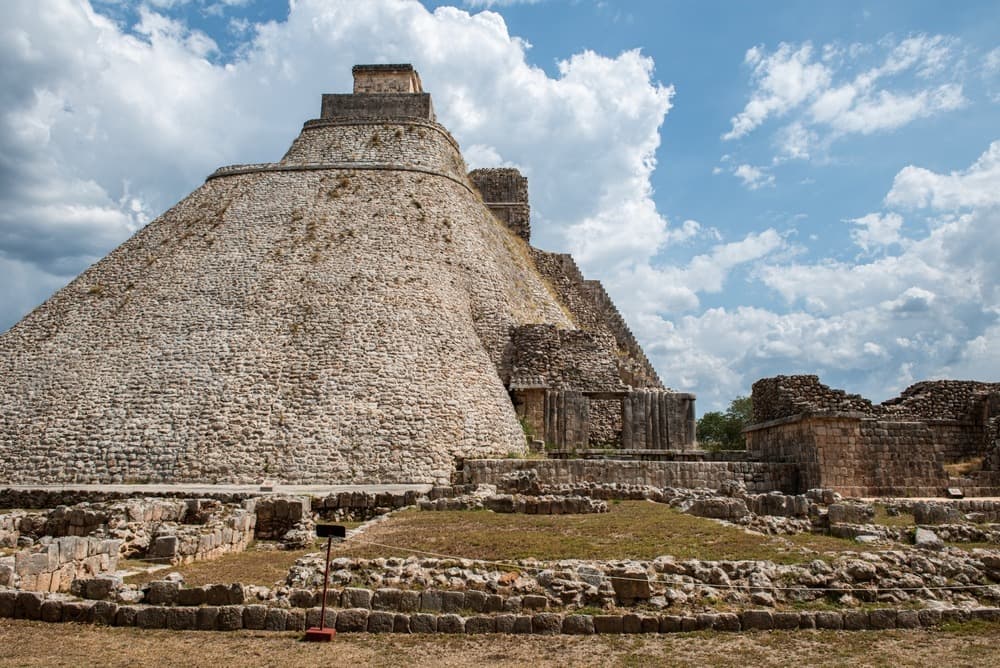
The site's most recognizable structure, it stands out for its elliptical plan—rare in Maya architecture. At approximately 35 meters high, it comprises five superimposed construction phases. Climbing is now prohibited to preserve the steps, but the view from the base remains striking.
The Nunnery Quadrangle
This complex of four palaces surrounding a central courtyard is considered the pinnacle of Puuc art. The upper friezes combine feathered serpents, Chaac masks, and geometric motifs spanning several hundred linear meters. The name "Nunnery" was a Spanish conquistador invention.
The Governor's Palace
Stretching nearly 100 meters, it rests on a triple artificial terrace. Its sculptural frieze runs the full length of the façade and represents one of pre-Columbian architecture's most elaborate compositions. The building's alignment is oriented toward the rising of Venus.
The Great Pyramid and the Dovecote
The partially restored Great Pyramid offers panoramic views of the entire site and surrounding forest from its summit. Nearby, the Dovecote (or House of Turtles) displays a frieze of carved turtles, an animal associated with rain in Maya cosmology.
Photography Tips
Morning light (before 10 a.m.) is ideal: it illuminates the eastern façades of the Nunnery Quadrangle and avoids harsh midday shadows. In late afternoon, the Pyramid of the Magician takes on a golden hue. Drones are prohibited without special authorization from INAH. Avoid using flash inside structures to prevent damage to residual pigments.
Location and Access
Uxmal is located in the state of Yucatán, approximately 80 km south of Mérida via Highway 261. The Puuc Route connects Uxmal to nearby archaeological sites (Kabah, Sayil, Labná) in a single-day loop. ADO buses and shared vans depart from Mérida; a rental car offers the most flexibility. No accommodations exist in the village itself, but several hotels are located in immediate proximity to the site.
Nearby Attractions
- Kabah — approximately 20 km south, famous for the Codz Poop, a façade covered with hundreds of Chaac masks.
- Sayil — a three-level palace set in a forested landscape, less visited than Uxmal.
- Labná — remarkable for its monumental arch, one of the best-preserved in the Puuc region.
- Mérida — the colonial capital of Yucatán, the natural starting point for exploring the Puuc Route.
- Chichén Itzá — another major Maya site in the Yucatán, approximately 180 km to the northeast, of different style and era.
Want to discover this destination?
Our local advisors design your tailor-made trip.