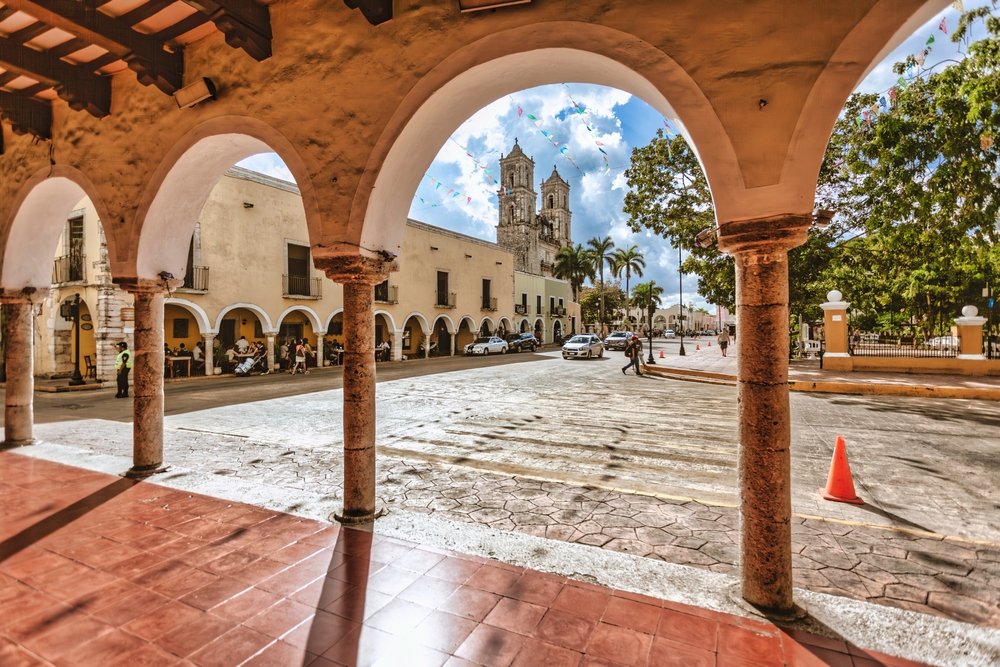
Cathedral of San Gervasio y San Protasio in Valladolid
Facing Valladolid's main plaza, the Cathedral of San Gervasio is one of the oldest religious buildings in Yucatán. Baroque limestone façade, gilded altarpiece, and colonial atmosphere steps away from cenotes.
In the heart of Valladolid, in the state of Yucatán, the Cathedral of San Gervasio occupies the eastern side of the parque principal, the city's central plaza. Built during the colonial period, it blends Franciscan simplicity with local baroque influences. It is one of the oldest religious buildings still in use in Yucatán, and an unmissable landmark for understanding the colonial history of this Mayan city.
Essential Practical Information
- Admission: free (active parish church)
- Location: facing the parque principal (Parque Francisco Cantón Rosado), Valladolid city center
- Recommended duration: 20 to 30 minutes
- Dress code: shoulders and knees must be covered
- Accessibility: level access through the main portal
What to See
The façade in yellow limestone, typical of Yucatán, features a baroque portal framed by pilasters. The single-nave interior preserves a main altarpiece and side altars adorned with statues of saints. Light filters through tall windows, creating a contemplative atmosphere. The tiled forecourt opens directly onto the lively plaza, making the transition between civic life and sacred space particularly striking.
History and Context
Valladolid was founded by the Spanish in 1543 on the site of a Mayan ceremonial center. A first church was built shortly after the city's founding. The current building dates primarily from the 17th century, rebuilt after destruction caused by Mayan uprisings. The cathedral bears the names of the martyrs Gervasius and Protasius, saints chosen as patrons by the first Franciscan settlers.
Highlights of Your Visit
The Façade and Its Baroque Portal
The main portal, carved from local stone, illustrates the simplified Churrigueresque style that characterizes colonial churches in Yucatán. The floral details and niches of saints deserve careful observation before entering.
The Main Altarpiece
Inside, the gilded altarpiece of the high altar concentrates the building's decoration. It combines Catholic iconography with local materials, reflecting the syncretism characteristic of colonial Yucatán.
The Plaza and Forecourt
The cathedral's forecourt merges with the parque principal. In the evening, the plaza comes alive with vendors and families; the illuminated façade offers a particularly lively backdrop.
Etiquette and Visiting Guidelines
- Shoulders and knees must be covered; a shawl or sarong will suffice.
- Silence and discretion during services (daily masses).
- Avoid crossing the church during religious ceremonies.
- Photography is generally permitted outside services, but without flash on artworks.
Photography Tips
Morning light (before 10 a.m.) illuminates the western façade directly without backlighting. In late afternoon, the limestone takes on a very photogenic golden hue. For a wide frame including the plaza, step back to the park's central kiosk. At night, artificial lighting on the façade allows for interesting long exposures.
Location and Access
The cathedral is located at Calle 41 s/n, facing Parque Francisco Cantón Rosado, in Valladolid's center. The city is accessible from Mérida (approximately 160 km to the east) and from Cancún (approximately 160 km to the west) via Highway 180. By bus, several companies (ADO notably) serve Valladolid from both cities. Walking from any downtown hotel, the cathedral is easily accessible.
Nearby Attractions
- Cenote Zaci — an open cenote in the city center, just a few blocks from the cathedral.
- Convent of San Bernardino de Sisal — 16th-century Franciscan complex with its own interior cenote, less than a kilometer away.
- Ek Balam Archaeological Site — Mayan city with a remarkably preserved acropolis, about thirty kilometers to the north.
- Chichén Itzá — major Mayan site, approximately 45 km west of Valladolid.
Frequently asked questions
As an active parish church, it is generally open outside night closure hours. Exact hours may vary; it is advisable to visit in the morning or early afternoon to be sure of access.
Admission is free. It is an active church open to both the faithful and visitors.
Yes, Cenote Zaci is just a few blocks away. Half a day is enough to visit the cathedral, stroll the plaza, and descend into the cenote.
Shoulders and knees must be covered. Bring a shawl or light garment to put on, especially if you are visiting in shorts or a summer dress.
Valladolid is a natural stop between Mérida and Chichén Itzá. The cathedral and central plaza can be visited in 30 minutes and provide a concrete overview of Yucatecan colonial architecture, very different from Mayan sites.
Interested in this visit?
We can include it in your personalised itinerary.