Campeche Archaeological Museum
Campeche Archaeological Museum
Located within San Miguel Fort, the Campeche Archaeological Museum brings together ten galleries dedicated to Maya cultures, including the jade masks from Calakmul.
The Campeche Archaeological Museum occupies San Miguel Fort, a former colonial fortress perched on Bellavista hill. Its ten exhibition galleries house one of the most representative Maya collections in southern Mexico, featuring pieces from the sites of Calakmul, Edzná, Jaina, and Becán.
Why visit the museum
Two qualities make this museum particularly compelling. First, its setting: an impeccably preserved 18th-century military fort complete with moats, bastions, and a central courtyard. Second, its collection: the jade funerary masks from the royal tombs of Calakmul rank among the most remarkable pieces in Maya archaeology. The museum thus offers a dual perspective on Campeche's history, bridging colonial defense and pre-Hispanic heritage.
History of San Miguel Fort
As early as 1771, Brigadier Antonio Oliver alerted authorities to weaknesses in Campeche's defenses and recommended reinforcing the most exposed zones with external fortifications. A provisional battery equipped with twelve cannons was constructed in 1776 near Bellavista hill, close to a former hacienda.
San Miguel Fort was subsequently built starting in 1779 according to plans by engineer Agustín Crame. In 1801, Colonel Juan José de León added two bastions on the land side to better protect the entrance. A coat of arms was then installed above the portal before being removed following Mexico's independence.
In the 20th century, the building briefly served as housing for military families, then remained abandoned for several years. In 1963, it was restored to house the Museum of Arms and Marine History. In 1978, its purpose changed: it became the Museum of Maya Archaeology. A renovation in 1999 redesigned the spaces and enriched the collection. The venue then took its current name: Campeche Archaeological Museum, San Miguel Fort.
What to see
Military architecture
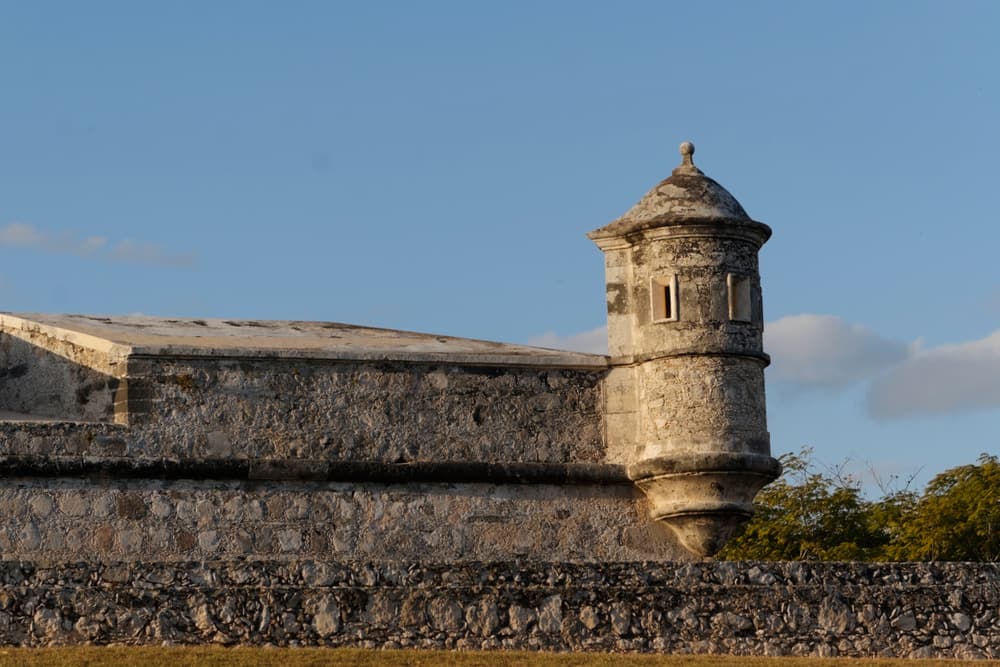
Even before stepping inside, the fort's exterior deserves attention. Its quadrangular layout is surrounded by moats crossed by two bridges: a fixed masonry bridge and a former wooden drawbridge. On the landward side, the two bastions added in 1801 frame the entrance. The sinuous access corridor, designed to impede any enemy advance, leads to a rectangular stone portal crowned with a triangular pediment.
The central courtyard, once the heart of military life, retains its cistern and provides access to original chambers: officers' quarters, soldiers' dormitories, storerooms, and kitchen. On the upper levels, parapets, esplanades, and three guard towers offered views of both land and sea.
The Maya collection
The ten exhibition galleries trace the pre-Hispanic cultures of the region. A handful of pieces capture the essence of the collection:
- Jade funerary masks discovered in the royal tombs of Calakmul, testifying to the refinement of the Petén Maya elite.
- Funerary figurines from Jaina island, celebrated for their realism and the finesse of their features.
- Calakmul Stela No. 9, whose carved inscriptions evoke a king and his consorts.
- Pieces from Becán, including a plate shaped as an iguana and a bowl depicting a black jaguar head.
- A sculpture from Edzná representing a queen carved from a stone drum.
Practical information
The museum is open Tuesday to Sunday, with continuous hours. Admission remains affordable, with typical free entry for children and Mexican seniors. Allow 1.5 to 2 hours to explore the entire fort and exhibition galleries. Explanations are primarily in Spanish; a guide or translation app may prove helpful.
The visit is conducted on foot throughout the fort: wear comfortable shoes and bring water, especially between April and September when the Yucatán Peninsula heat is intense. November through March offers milder conditions and represents the best season to combine this visit with other sites in the region.
How to get there
San Miguel Fort is located approximately 4 km southwest of Campeche's historic center, on Bellavista hill. Access by car or taxi is most straightforward, taking about ten minutes from downtown. A few local buses serve the southern coast and stop at the base of the hill, though the final climb is on foot. Parking is available on-site.
To combine with
The counterpart to San Miguel Fort is San José el Alto Fort, located north of the city and housing another museum. Campeche's fortified historic center, a UNESCO World Heritage site, merits a full day with its colorful streets, bastions, and museums. To extend Maya exploration, the archaeological site of Edzná lies approximately 1 hour away by car. Further afield, the Convent of San Bernardino de Siena and Monte Albán complete a cultural journey through Mexico.
Frequently asked questions
Frequently asked questions
Include the museum in your trip
The Campeche Archaeological Museum fits naturally into an itinerary around the Yucatán Peninsula and major Maya sites. To craft a tailor-made route including Campeche and other cultural highlights of the country, explore our Mexico travel suggestions.
Interested in this visit?
We can include it in your personalised itinerary.