Lucha Libre
Lucha Libre
Mexico's emblematic sport-spectacle, lucha libre comes alive in Mexico City within two historic arenas. History, rules, masks, and practical tips.
Lucha libre is one of Mexico's most recognizable cultural expressions. Blending combat sport, popular theater, and mask artistry, it thrives primarily in Mexico City, within two historic arenas that host weekly technical bouts, hair-stake matches, and choreographed rivalries between Técnicos and Rudos.
Why attend a lucha libre match
Beyond the spectacle, lucha libre offers a window into Mexican popular culture. The audience participates actively, singing, whistling, and cheering: it's a family outing as much as an urban ritual. The masks, which have become graphic icons, tell a mythology where each luchador embodies a character with his own story, style, and longtime rivals.
Recognizing this cultural dimension, Mexico City designated lucha libre as intangible cultural heritage in 2018. That same year, the Senate established September 21 as the National Day of Lucha Libre and Mexican Professional Wrestlers.
History of lucha libre
The roots of lucha libre trace back to the French intervention in Mexico (1863–1867), a period when Greco-Roman wrestling matches were presented in the country. But the official birth date is 1933. Salvador Lutteroth González, a former tax inspector, drew inspiration from catch wrestling spectacles he'd seen in El Paso, Texas, and founded the Empresa Mexicana de Lucha Libre (EMLL), now known as CMLL. To host the matches, he transformed the Arena Modelo, a former boxing hall, into an entertainment venue.
As popularity grew, new arenas emerged: Arena Coliseo in 1943, then Arena México in 1956, soon dubbed "the cathedral of lucha libre." The golden age arrived in the 1950s with legendary figures like El Santo and Blue Demon, whose fame extended far beyond the ring into film, comic books, and popular culture.
Understanding the spectacle
Técnicos versus Rudos
Matches traditionally pit two types of wrestlers against each other. Técnicos are the heroes: they respect the rules, wrestle with fair play, and often wear bright colors that make them immediately recognizable. Facing them, Rudos play the antagonists, employing underhanded tactics and provocations. Some Rudos have become quite popular as antiheroes, like Perro Aguayo Jr.
Technically, lucha libre draws from Olympic wrestling, judo, and jiu-jitsu. Técnicos favor aerial wrestling, featuring acrobatics and rope-based jumps, while Rudos rely more on grappling and strength.
Main rules
In Mexico, matches are fought as a best-of-three falls, a rule preserved locally though abandoned in the United States and Japan since the 1970s. To win, a luchador must keep his opponent pinned on the mat for a count of three, secure a submission, or wait for the opponent to remain outside the ring beyond the count (roughly twenty seconds).
Several moves are penalized: resting on the ropes, refusing to break a hold, or using moves deemed dangerous. The piledriver is generally banned. Removing an opponent's mask results in immediate disqualification.
The mask, the luchador's signature
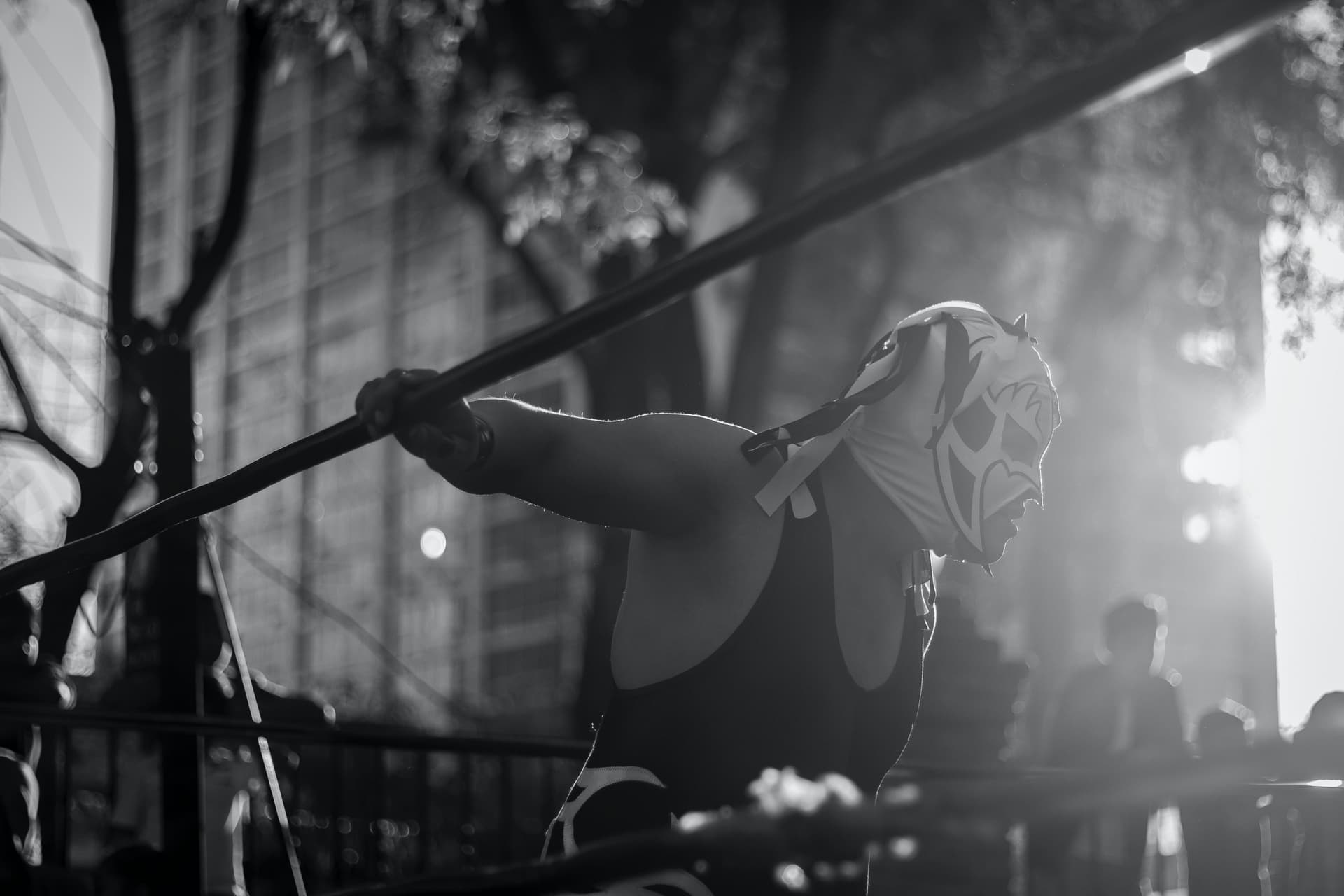
The mask conceals the wrestler's identity and is integral to his character. Originally simple and monochromatic, they've become elaborate graphic objects, featuring bright colors and patterns inspired by animals, deities, or fantastical creatures. Losing one's mask often marks a turning point in a career.
Some luchadors, who wrestle unmasked, stake their hair in important matches: these are the luchas de apuestas. If they lose, the defeated wrestler is shaved bald in the ring before the crowd.
Where to watch a match in Mexico City
Arena México
Inaugurated in 1956 in Colonia Doctores, Arena México is the premier venue, with a capacity of roughly 16,000 spectators. It hosts the most high-profile CMLL events, including the famous viernes espectaculares Friday nights. The arena is close to the Roma and Condesa neighborhoods, easy to reach. For your return after the show, a ride-hailing service is preferable to walking.
Arena Coliseo
Smaller and circular in shape, Arena Coliseo sits in the historic center, near the Tepito district. Its reduced size brings spectators closer to the action and gives it a rawer atmosphere, prized by enthusiasts. Since the surrounding neighborhood is lively and working-class, it's best to go in a group or with a guide, and to opt for private transport in the evening.
Practical information
- Match days: at Arena México, main events on Tuesday (CMLL) and Friday evenings (prime programming). At Arena Coliseo, typically Sunday.
- Tickets: affordable prices with a wide range depending on seating. Seats closest to the ring are most expensive; upper bleachers offer good value and an overview of the spectacle.
- Booking: CMLL online ticketing or box office on site. For Friday nights at Arena México, advance purchase is recommended.
- Duration: plan for roughly 2 to 3 hours for a full card of several matches.
- Photos and masks: souvenirs (masks, figurines, t-shirts) are sold around the arenas; quality varies, so compare before buying.
See nearby
Both arenas are well-positioned to combine your evening with other capital attractions. Arena Coliseo is a few blocks from the historic center of Mexico City, ideal to explore during the day. Arena México is easily accessible from Roma and Condesa. To extend your stay, the bohemian neighborhood of Coyoacán and the Basilica of Guadalupe rank among the city's most memorable stops.
Frequently asked questions
Frequently asked questions
A full evening chains several bouts together and typically lasts between 2 and 3 hours. Each individual match is fought as best-of-three falls and can run from a few minutes to around twenty minutes depending on the storyline.
Yes, stands set up around Arena México and Arena Coliseo sell masks, t-shirts, and figurines. Quality and prices vary considerably; for more elaborate pieces, specialized shops in the city center are worth seeking out.
Yes. Lucha libre is a family outing in Mexico, and many children attend shows with their parents. The atmosphere is festive and more theatrical than violent. Upper-level seats work well for families; ringside seats can be quite intense.
For Friday nights at Arena México, which are the most popular, online booking is recommended. For other dates and at Arena Coliseo, it's usually possible to buy a ticket at the box office the same day.
Arena México, in Colonia Doctores, is easy to access and the zone remains busy on match nights. Arena Coliseo borders Tepito, a working-class neighborhood best crossed during the day or by private transport. In both cases, arranging a ride-hailing service for your return is the simplest solution.
Plan your trip
Lucha libre integrates easily into a Mexico City stay, complementing the country's major historic and cultural sites. To build an itinerary including the capital, the Yucatán, or the highlands, check out our trips to Mexico.
Nearby
Interested in this visit?
We can include it in your personalised itinerary.