Calakmul Archaeological Site
Calakmul Archaeological Site
A major Maya city in southern Campeche, Calakmul combines monumental pyramids, royal tombs and a 7,000 km² biosphere reserve.
Calakmul is one of the great Maya cities of the Lowlands, hidden deep in the jungle of southeastern Campeche, near the Guatemalan border. The site stands out for the scale of its architecture, the richness of its royal tombs and its integration into a biosphere reserve of more than 7,000 km². It receives fewer visitors than Chichén Itzá or Palenque, due to its remote location.
Why visit Calakmul
Calakmul combines three rare assets on a single site. First and foremost, it was a major political capital: between 636 and 695 CE, it structured a vast network of alliances that rivaled Tikal. Second, it is a dense architectural complex, with two pyramids exceeding 40 and 50 meters and several acropolises serving residential, administrative and funerary functions. Third, it preserves a pristine natural environment: the Calakmul Biosphere Reserve is home to jaguars, tapirs, howler monkeys, spider monkeys and several hundred bird species.
The visiting experience is unrestricted. You can climb most structures, walk around the plazas and observe the stelae at your own pace, with no guided circuit required.
History of the site
The name Calakmul comes from Yucatec Maya and means "two neighboring hillocks," referring to Structures I and II that still dominate the canopy. Inscriptions also reference the city by other names: Kan, meaning "serpent," and Ux te tuun, translating to "three stones."
Occupation of the site dates back to 550 BCE. Its peak falls between 250 and 900 CE. Between 636 and 695, Calakmul exerted considerable political influence over the Maya Lowlands before being defeated by Tikal. It then reoriented northward and forged alliances with cities in the Rio Bec region. Between 1000 and 1500, after the city's decline, the place retained pilgrimage functions.
Excavations have yielded funerary goods of exceptional quality: painted vessels, jade jewelry and masks, objects in shell and wood. Calakmul is particularly associated with one of the largest documented series of jade funerary masks in the Maya world.
What to see on site
The Great Acropolis
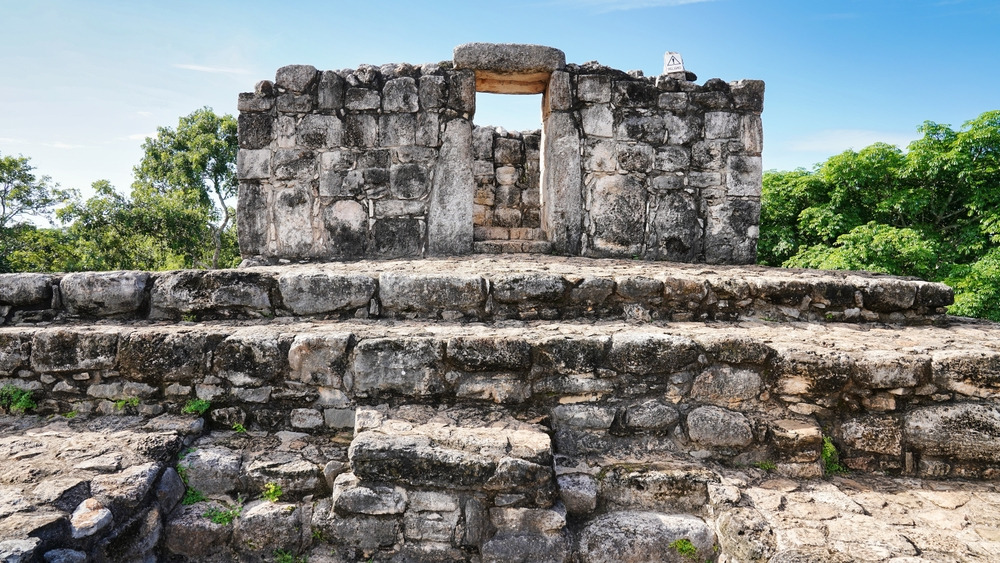
This is the first major complex you encounter following the main trail. This residential area divides into two sections. A semi-public area brings together about ten buildings around two plazas separated by Structure XII, including a ball court, historically accessed via Structure XIV. The private quarter, reserved for the elite and the governor, groups some 70 constructions arranged around 17 patios and plazas. Structure XV yielded three tombs during excavation.
The Great Plaza and Structure II
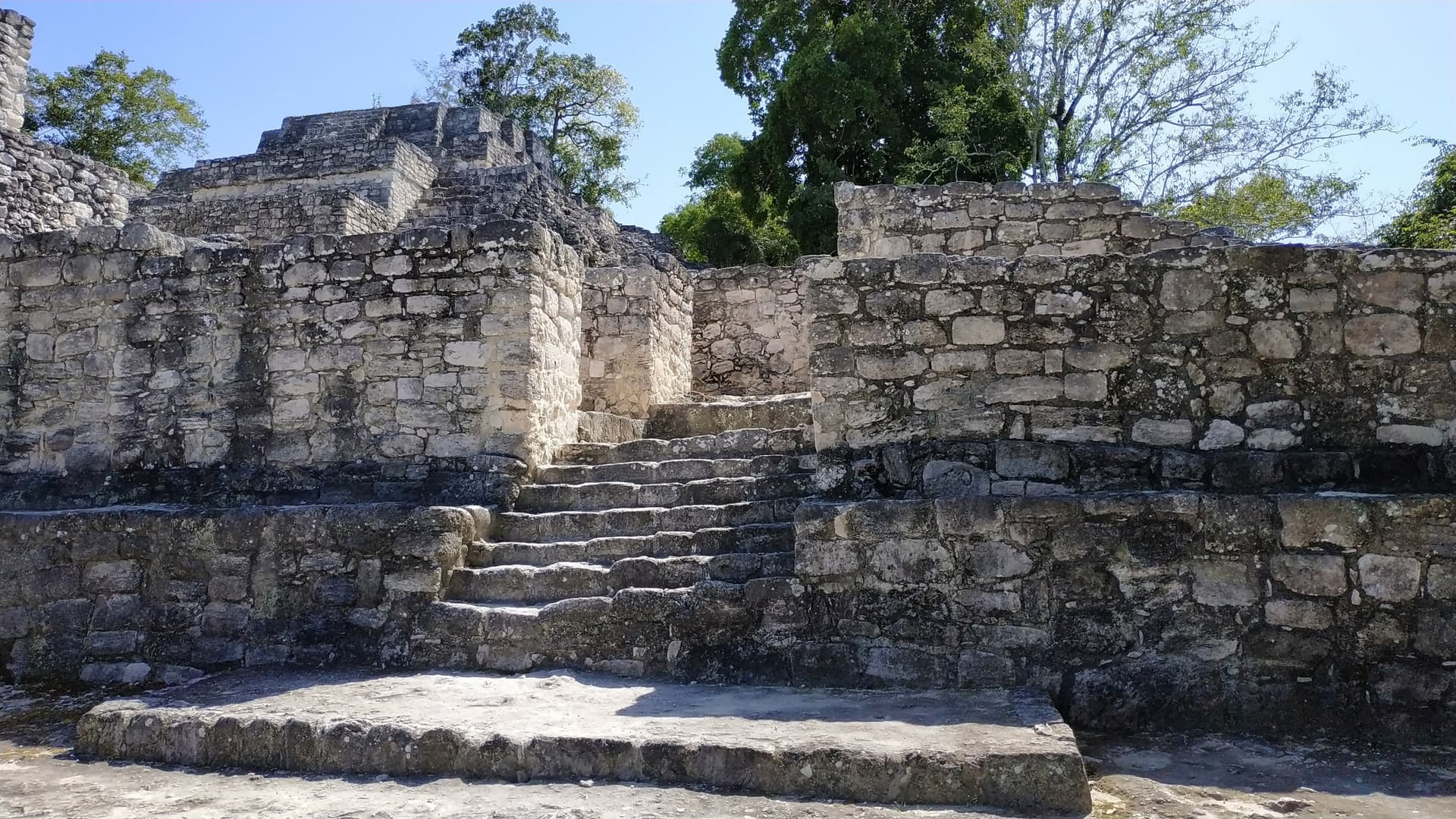
The Gran Plaza forms the ceremonial heart of the city. It is dominated by Structure II, the tallest pyramid on the site. It stands at approximately 50 meters today and reached nearly 60 meters at its height, making it one of the most voluminous pyramids in the Maya world. Nine funerary chambers have been identified within it, housing city leaders. From the summit, the view breaks through the canopy, revealing other structures rising from the forest.
Structure I
At 40 meters, Structure I is the site's second-largest pyramid. The steps are irregular, so exercise caution when ascending and descending. The summit offers a frontal view of Structure II above the trees.
The Small Acropolis and Structure III
The last complex on the tour, the Pequeña Acrópolis has been less restored than other complexes. Structure III, at its edge, served as a palace for one of Calakmul's oldest ruling families. Two tombs were excavated there, one accompanied by pottery and jade masks. Plaques bearing hieroglyphic inscriptions confirm the deceased's elevated status.
Chii'k Naab and Chan Chi'ich
Chii'k Naab groups 68 constructions arranged around plazas and passages, likely used for ceremonies and collective gatherings. Chan Chi'ich corresponds to a residential zone of extended lineages, where archaeologists uncovered a drainage canal designed to evacuate rainwater.
Wildlife in the reserve
The reserve harbors abundant fauna, best observed early in the morning. You may encounter jaguars, ocelots, tapirs, howler monkeys, spider monkeys, anteaters, armadillos, as well as toucans, ocellated turkeys, crested trogons, parrots and parakeets.
When to visit Calakmul
The dry season, from November to April, is most favorable. Trails remain passable, heat is manageable early in the day and paths are not slippery.
Between December and February, wildlife observation is particularly rewarding: it is jaguar breeding season, and mosquito pressure is noticeably lower.
How to reach Calakmul
The site lies in southeastern Campeche State, about 4 hours from the city of Campeche, 2 hours 15 minutes from Bacalar and 40 minutes from Xpujil. From the reserve entrance, allow another hour to reach the archaeological zone on a track where driving is slow.
By car
From Campeche, take Route 261 south to Escárcega, then Route 186 toward Chetumal. At kilometer 95, in the village of Conhuas, turn south for 60 km. Important: no gas stations between Escárcega and Xpujil, so fill up beforehand.
From Bacalar, the route goes via México 186 through Villahermosa.
By public transport
The simplest option is to reach Xpujil by bus from Campeche, Bacalar or Chetumal, then spend the night there. A shuttle serves the site the following morning, with return early afternoon, round-trip ticket. Several companies (ADO, Autobuses Sur, AU) operate these routes; schedules and fares change regularly, verify before departure.
Practical information
- Plan 3 to 5 hours on site to tour the main complexes without rushing.
- Bring water, a hat, closed-toe shoes and insect repellent.
- Arrive early: light is better and wildlife more active in the morning.
- Mobile network is very limited in the reserve.
- A local guide significantly enhances the visit, especially for wildlife identification.
Nearby
The Rio Bec region concentrates several Maya sites accessible in the same circuit: Becán, Chicanná and Xpujil offer architectures distinct from Calakmul. Further east, Cenote Cocalitos and Bacalar lagoon allow you to extend the itinerary in a more aquatic vein. For those staying with archaeology, Chichén Itzá in northern Yucatán and Monte Albán in Oaxaca State round out the major pre-Hispanic capitals. The city of Campeche makes a logical stop before or after visiting.
Frequently asked questions
Frequently asked questions
Allow 3 to 5 hours on site itself to tour the Great Acropolis, the Great Plaza, Structures I and II and the Small Acropolis. Adding travel time from the reserve entrance and return, a full day is needed.
The visit is self-guided and signage helps orient you. A guide is still highly recommended to understand the city's political history, read the stelae and spot wildlife, often invisible to untrained eyes.
Jaguars inhabit the reserve but avoid frequented areas. Sightings on the site itself are rare and accidental. No special precautions are required beyond common sense: stay on trails and do not venture off late in the day.
Several accommodations exist in Xpujil and along Route 186, as well as a few cabañas closer to the reserve entrance. Staying nearby allows you to depart early the next morning and optimize wildlife observation.
Yes, access to Structures I and II and several other buildings remains permitted. The steps are irregular and tall, closed-toe shoes are essential.
Plan your trip
Calakmul naturally integrates into an itinerary combining the Yucatán Peninsula, Campeche and the Rio Bec lakes region. To build a custom trip including this site and other major Maya destinations, explore our Mexico journeys.
Interested in this visit?
We can include it in your personalised itinerary.