Basilica of Guadalupe
Basilica of Guadalupe
A major sanctuary of Latin American Catholicism, the Basilica of Guadalupe welcomes 20 million pilgrims annually north of Mexico City on the Tepeyac hill.
North of Mexico City, on the Tepeyac hill, the Basilica of Guadalupe welcomes roughly twenty million visitors and pilgrims each year. It is one of the most visited Catholic sanctuaries in the world, dedicated to the Virgin of Guadalupe, a major figure in Mexican religious identity.
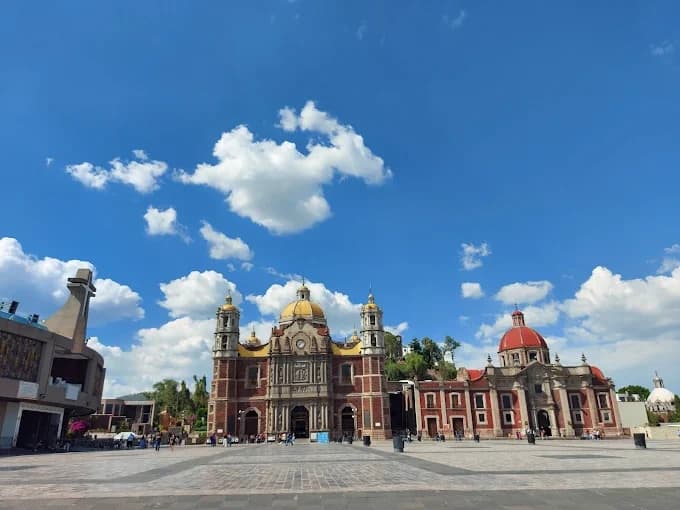
The site actually brings together several buildings: the new basilica inaugurated in 1976, the 18th-century old basilica, several historic chapels, a sacred art museum, and the Tepeyac gardens. The atmosphere is rarely contemplative: the faithful sometimes arrive on foot from other cities, sometimes on their knees over the final stretch, flowers and candles in hand.
Why visit the Basilica of Guadalupe
The sanctuary concentrates three interests that make it a unique visit within Mexico City:
- A living religious dimension: the basilica preserves the tilma of Juan Diego, the mantle upon which the image of the Virgin is said to have appeared in 1531. It is the most visited object of devotion in Latin American Catholicism.
- A varied architectural ensemble: from the Mexican baroque of the old basilica to the circular reinforced concrete shell of 1976, the site spans four centuries of construction.
- A human experience: observing the pilgrims, the singing, the processions, and the ex-votos provides a direct glimpse into Mexican religious culture, mestizo and popular in character.
History and origins of the sanctuary
The story begins in December 1531. Juan Diego, a recently converted Nahua indigenous person, claims to have seen the Virgin Mary appear to him on the Tepeyac hill. She asks him to convince the bishop to build a church at this location. The bishop demands proof.
On December 12, during a second appearance, the Virgin asks Juan Diego to gather flowers on the barren hill. He collects them in his mantle of cactus fiber. When he unfolds the cloth before the bishop, the image of the Virgin appears on it. It is this tilma, still preserved today, that founded the cult.
A first chapel is built as early as the end of 1531. The old basilica is completed in the early 18th century and proclaimed a basilica in 1904. Mexico City's clay soil, unstable, eventually threatens its stability. A new basilica is then constructed in its immediate vicinity and inaugurated in 1976 to accommodate growing crowds.
What to see on the site
The new basilica (1976)
Designed by architect Pedro Ramírez Vázquez, the building rests on a circular plan measuring 100 meters in diameter. The absence of interior pillars ensures total visibility of the altar from any seat. Capacity reaches 10,000 people inside, and up to 100,000 including the outdoor esplanade.
The tent-shaped roof references the biblical exodus and Mary's protective mantle. Its copper covering has turned green through oxidation. The reinforced concrete structure organizes around a central column 42 meters tall housing the sanctuary offices. Seven large doors allow entry and exit without bottlenecking on high-traffic days.
Behind the altar, the image of the Virgin is displayed at worshippers' eye level. To allow everyone to see it up close without interrupting masses, moving walkways have been installed beneath the image. To the right of the altar, a monumental organ with several thousand pipes completes the liturgical equipment. A relief reproduction of the image, accompanied by braille text, serves visually impaired visitors.
In the basement, crypts house over 15,000 burial niches and ten chapels.
The old basilica
Completed in the early 18th century, it illustrates Mexican baroque: sculpted façade, twisted columns, original retables, and interior frescoes. Restored to stabilize its leaning structure, it remains visitable and retains a more intimate atmosphere than the new basilica.
Chapels of Pocito
Built in the 18th century over a spring considered miraculous, this small chapel stands out for its blue and white mosaic dome. It is one of the finest baroque works on the site.
Chapels of Cerrito
Located at the summit of Tepeyac hill, it marks the location of the apparitions. The climb is by staircase or an improved pathway.
Capilla de Indios
One of the sanctuary's oldest chapels, built for the first indigenous converts. Its sober interior reflects the mestizo dimension of Guadalupan devotion.
The sacred art museum
The museum displays paintings, sculptures, liturgical vestments, and objects of worship related to the Virgin of Guadalupe. The pieces are accompanied by explanatory panels.
The Tepeyac gardens
Bordered by statues and fountains, the gardens connect the various chapels. From the hilltop, the view extends over the Mexico City valley and, on clear days, the volcanoes that encircle it.
Practical information
- Access: free entry to the basilica and chapels. The museum applies a modest fee.
- Hours: broad opening daily, early morning until evening. Masses follow one another throughout the day.
- Dress code: no strict code, but attire covering shoulders and knees is expected inside religious buildings.
- Photography: permitted in most areas, without flash and outside mass times. Avoid photographing worshippers in prayer up close.
- Visit duration: allow 2 to 3 hours to explore the new basilica, the old one, the hill, and the museum.
When to visit
The sanctuary is open year-round. The choice of date depends on what you wish to experience.
- Around December 12: feast of the Virgin of Guadalupe. Several million pilgrims converge on the site in the days before and after. The experience is striking (singing, dancing, overnight vigils), but access to buildings is very difficult and lines are long.
- Rest of the year: attendance remains high on Sunday, the main mass day, and quieter on weekdays.
- Early morning: the best time to visit interior spaces without excessive crowds.
How to get there
The basilica is located in the La Villa neighborhood, north of Mexico City, approximately 5 km from the historic center.
- Metro: La Villa-Basílica station on line 6 (red). Allow 5 to 10 minutes walking to the sanctuary entrance.
- Taxi or ride-sharing: convenient option from the Centro Histórico or Zona Rosa, in 20 to 40 minutes depending on traffic.
- Hop-on hop-off tours: several Mexico sightseeing circuits include a stop at the basilica.
To combine with your visit
The basilica can be visited in a half-day, leaving time to explore other major sites in Mexique on a broader itinerary:
- Monte Albán, the ancient Zapotec capital in the Oaxaca valley.
- The San Bernardino de Siena convent, another striking example of colonial religious architecture.
- Street art in Oaxaca, for a more contemporary reading of Mexican culture.
- The San Felipe de Bacalar fort, on the Caribbean coast.
Frequently asked questions
Frequently asked questions
No strict dress code, but attire covering shoulders and knees is expected inside religious buildings. Avoid short shorts and tank tops, especially during masses.
Yes. The image is displayed behind the main altar of the new basilica. Moving walkways installed beneath the image allow visitors to pass by and observe it up close without interrupting celebrations.
It depends on your objective. To experience Mexico's most important religious event, this is the date to choose. To visit the buildings peacefully, it is better to come on a weekday outside this period, as crowds are then massive.
Plan your trip to Mexique
The Basilica of Guadalupe integrates naturally into a Mexico City stay, which can be extended to archaeological sites, colonial cities, and the country's coasts. To build a custom itinerary, consult our journeys in Mexique.
Nearby
Interested in this visit?
We can include it in your personalised itinerary.