Mayapán Archaeological Site
Mayapán Archaeological Site
Mayapán, the last Maya capital of the Yucatán (13th–15th centuries), offers pyramids, frescoes and sacred cenotes in a relatively undiscovered setting, 45 km from Mérida.
Mayapán was the last great Maya capital of the Yucatán, dominating the peninsula between the 13th and 15th centuries. Less visited than Chichén Itzá or Uxmal, this archaeological site offers a direct insight into late Maya urbanism: a fortified, densely built city enclosed by a stone wall, with over 4,000 structures recorded across just a few square kilometers. It remains an active excavation site where the political history of the post-Classic Maya civilization is written in stone.
Practical Information at a Glance
- Admission: paid (site managed by INAH); separate ticket for the federal zone
- Recommended duration: 2 to 3 hours to explore the main areas
- Access: by car from Mérida (approximately 45 km southeast) or by colectivo heading toward Telchaquillo
- Attire: closed-toe shoes recommended — uneven terrain, dense vegetation
- Note: limited shade in some areas; water and hat are essential
What You'll See
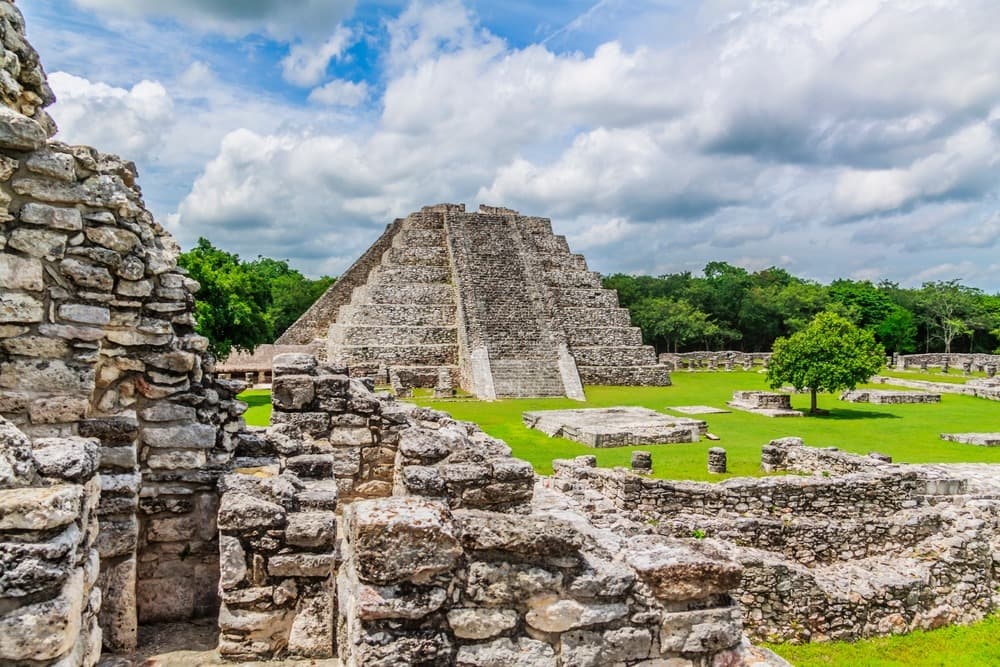
The site encompasses several hundred restored or partially uncovered structures. The main pyramid, El Castillo de Kukulcán, deliberately mimics the one at Chichén Itzá — a sign of the political legitimacy sought by Mayapán's rulers. Also on view are round temples dedicated to Kukulcán, ceremonial platforms, sacred cenotes, and remains of elite residential buildings.
The stelae and stucco masks on façades, though fragmentary, testify to vibrant artistic activity during the post-Classic period. Several buildings retain traces of murals.
History and Context
Founded around 1200 CE, Mayapán served as the seat of the League of Mayapán, a confederation uniting the great Yucatecan dynasties — Cocom, Xiu, Itzá. The city reached an estimated population of 15,000 inhabitants, exceptional for its time.
In 1441, a rebellion led by the Xiu overthrew the Cocom and destroyed the city. Mayapán never recovered. By the arrival of the Spanish, the Yucatán had fragmented into rival small states — a direct consequence of this collapse. Excavations, conducted since the 1950s by the Carnegie Institution and later by INAH, have revealed the true extent of the city.
Highlights of Your Visit
El Castillo de Kukulcán
The central stepped pyramid is the tallest structure on the site. Its square plan with nine levels and main staircase explicitly echo Chichén Itzá. From the summit, views over the Yucatecan plain and surrounding vegetation are unobstructed.
The Temple of Frescoes
Several structures retain fragments of murals depicting deities and ritual scenes. These remains represent some of the rare examples of post-Classic Maya painting in situ in the Yucatán.
The Site's Cenotes
Two cenotes are integrated into the ceremonial space. They served both as a water source and as a place for offerings. Their presence at the heart of the city underscores the sacred role of water in Maya urbanism.
The Fortified Enclosure
A stone wall with a perimeter of approximately 9 km surrounded the city — a rare occurrence in Maya architecture. This rampart, still partially visible, testifies to a politically tense context among rival cities.
Photography Tips
Morning light (before 10 a.m.) is most favorable: it illuminates the east façade of El Castillo without backlighting. Vegetation creates interesting shadow play on secondary structures mid-morning. No known photography restrictions for individual visitors, but flash is discouraged inside structures.
Location and Access
Mayapán is located approximately 45 km southeast of Mérida, near the village of Telchaquillo. By car, allow less than an hour from the Yucatecan capital. Colectivos depart from Mérida toward Acanceh or Telchaquillo; from these villages, a local taxi or moto-taxi can get you to the site entrance. Accessibility for persons with reduced mobility is limited due to the unimproved natural terrain.
Nearby Attractions
- Uxmal — Major Maya site in the Puuc style, approximately 80 km to the west; among the most refined architecture in the Yucatán.
- Chichén Itzá — Mexico's most visited Maya city, approximately 120 km to the east; a direct point of comparison with Mayapán.
- Mérida — Capital of the Yucatán, an ideal logistical base, less than an hour's drive away.
- Acanceh — A neighboring town where a Maya pyramid stands in the main plaza, just a few kilometers from Mayapán.
Frequently asked questions
The dry season (November to April) is most comfortable. In summer, heat and humidity are intense and showers frequent. Regardless of season, arrive early in the morning to avoid midday heat.
Yes. From Mérida, one day allows you to visit Mayapán in the morning and Acanceh on the way. Chichén Itzá or Uxmal each require a full day to themselves.
Yes, provided you bring water, a hat, and wear closed-toe shoes. The terrain is uneven and offers limited shade. The cenotes and main pyramid typically captivate children.
INAH-certified guides are generally available at the site entrance. It is advisable to request them directly at reception; rates are negotiable on-site.
Significantly so. Mayapán receives a fraction of Chichén Itzá's visitors, allowing for a quieter visit and better immersion in the site. This is a real advantage for archaeology enthusiasts.
Interested in this visit?
We can include it in your personalised itinerary.