Palace of Fine Arts
Palace of Fine Arts
National monument, museum and opera house in Mexico City: Art Nouveau façade, Art Deco interior, muralist frescoes and Tiffany glass stage curtain.
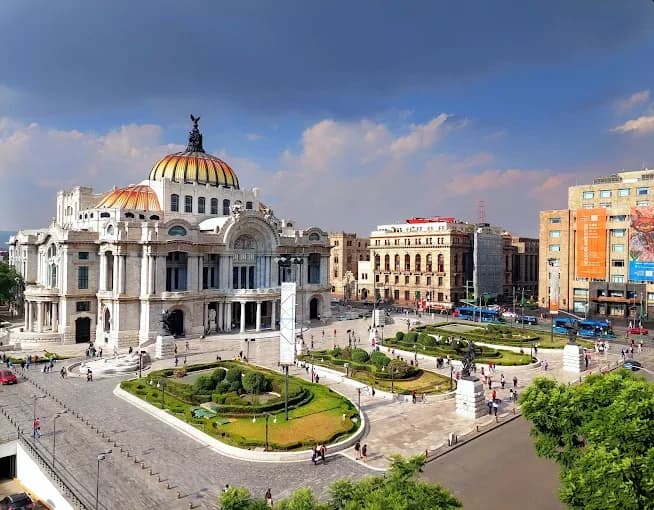
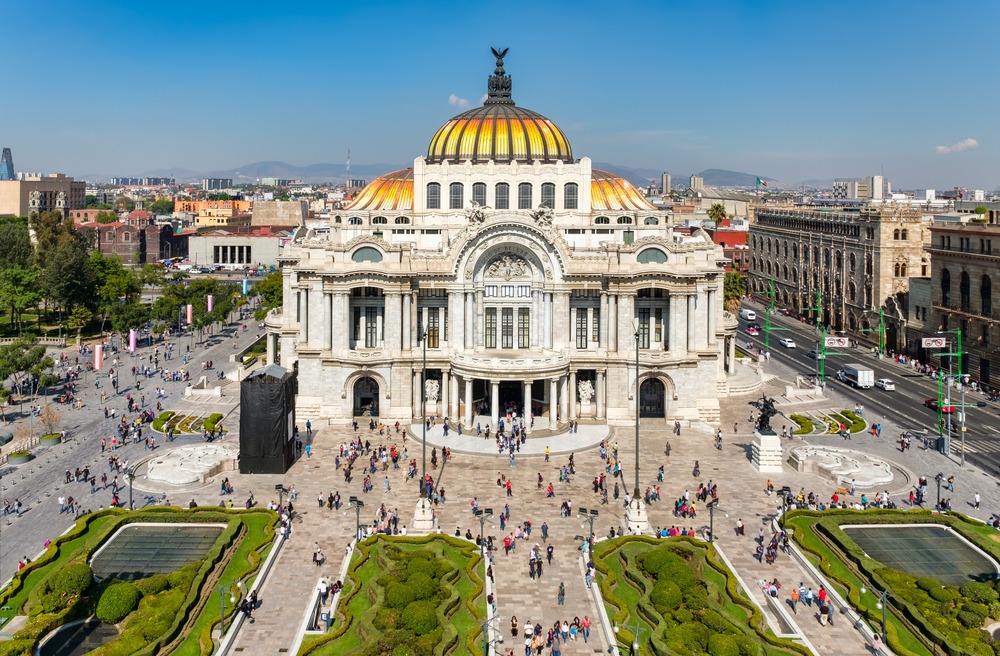
The Palace of Fine Arts (Palacio de Bellas Artes) occupies the northeast corner of Alameda Park, in the heart of Mexico City's historic center. A venue for performances, a museum and a national monument all in one, the building combines an Art Nouveau envelope of white marble with an Art Deco interior adorned with frescoes by Mexico's great muralists. UNESCO inscribed it among Mexico's artistic monuments in 1987.
Why visit the Palace of Fine Arts
Three compelling reasons justify a visit, however brief:
- Hybrid architecture: European façade in Carrara marble, Art Deco interior enriched with pre-Hispanic motifs (serpent heads, Chaac masks).
- Mexican muralism gathered in one place: frescoes by Diego Rivera, José Clemente Orozco, David Alfaro Siqueiros and Rufino Tamayo, displayed in galleries on the first two floors.
- Tiffany glass stage curtain: a panel of roughly one million pieces of colored glass depicting the volcanoes Popocatépetl and Iztaccíhuatl, visible only during certain performances or guided tours.
The building can be visited in 1 to 2 hours depending on whether you include the architecture museum on the top floor.
History of the palace
In the 17th century, the Santa Isabel convent occupied this site. Following 19th-century secularization, the land hosted residences and then industrial activity, before a national theater was built there at century's end.
In 1904, marking the centennial of Mexico's independence, President Porfirio Díaz launched a new cultural project and entrusted its design to Italian architect Adamo Boari. Construction began in Art Nouveau style, but technical difficulties resulting from Mexico City's soft soil, followed by the Mexican Revolution, halted it. The project remained stalled for nearly two decades.
In the 1930s, work resumed under Mexican architect Federico Mariscal, who redesigned the interior in a more contemporary Art Deco vocabulary. The palace was inaugurated in 1934. UNESCO inscribed it among artistic monuments in 1987.
Built on the clay soil of the former Lake Texcoco, the building has settled slowly since its construction—a phenomenon common to heavy structures in the historic center.
What to see on site
Façade and exterior
The façade is clad in white Carrara marble and faces Avenida Juárez. At the entrance, sculptures by Leonardo Bistolfi represent "Harmony" surrounded by "Sorrow," "Rage," "Happiness," "Peace" and "Love." On either side, statues of Pegasus were relocated from the Zócalo. The central glass and iron roof depicts Apollo surrounded by the muses.
Several pre-Hispanic details rendered in Art Deco vocabulary appear on the exterior: serpent heads above windows and Mayan masks of the rain god Chaac on luminous panels.
Interior and galleries
- First floor: crystal lamps by Edgar Brandt and frescoes by Rufino Tamayo.
- Second floor: major ensemble of Mexican muralism featuring works by José Clemente Orozco, Diego Rivera (including a new version of the fresco originally censored at Rockefeller Center) and other 20th-century artists.
- Third floor: National Architecture Museum, devoted to the history of Mexican building.
Performance hall
At the theater entrance, bronze mascaron heads evoke the water deities Tlaloc (Aztec) and Chaac (Maya). The hall seats approximately 1,590 spectators. Its stage curtain, executed in the workshops of Géza Maróti in Hungary from roughly one million pieces of colored glass produced by Tiffany in New York, weighs 24 tons and depicts the volcanoes Popocatépetl and Iztaccíhuatl. It is one of the most singular pieces in the building.
Practical information
- Opening days: generally Tuesday to Sunday, closed Monday (check the official website before visiting).
- Recommended duration: allow 1 hour for the frescoes, 2 hours including the architecture museum.
- Tickets: moderate admission for galleries, free access to the main hall. Separate fees for the Architecture Museum and performances.
- Photography: permitted without flash in galleries (a surcharge may apply); prohibited during performances.
- Viewing the Tiffany curtain: it is deployed only during certain Ballet Folklórico performances or specific guided tours.
How to get there
- Metro: Bellas Artes station, at the intersection of lines 2 and 8, steps from the palace.
- Metrobús: line 4 on Avenida Hidalgo, stop nearby.
- Trolebús: runs on Eje Central with a stop at the palace.
- Bicycle: several EcoBici stations are located around Alameda.
- On foot: approximately 10 minutes from the Zócalo, following Madero Street.
Nearby
The palace sits in a neighborhood dense with cultural sites that combine easily over half a day:
- Alameda Central: Latin America's oldest public park, just across the way.
- Museo Mural Diego Rivera: houses the fresco Dream of a Sunday Afternoon in Alameda Park, a 5-minute walk away.
- Torre Latinoamericana: its observation deck offers the best aerial view of the palace and its ceramic roof.
- Casa de los Azulejos and Madero Street: pedestrian axis connecting Bellas Artes to the Zócalo.
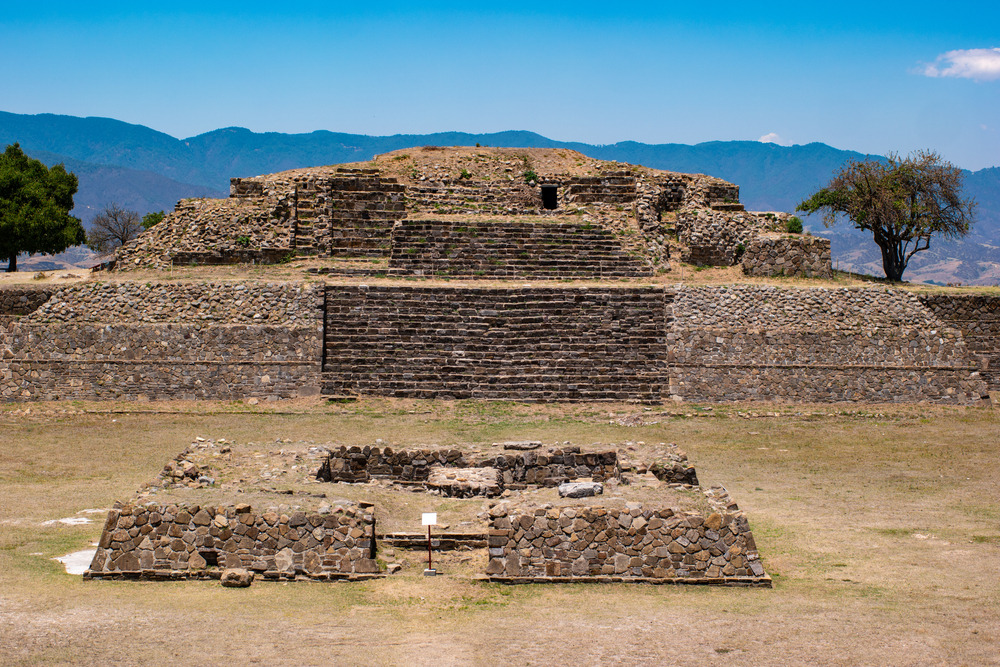
To extend your journey beyond Mexico City, several destinations merit a visit: the Zapotec site of Monte Albán near Oaxaca, the artistic scene of Oaxaca that carries forward the muralist spirit, or the Convent of San Bernardino de Siena in the Yucatán.
Frequently asked questions
Including the palace in your trip
The Palace of Fine Arts integrates naturally into your first day in Mexico City, complementing the Zócalo, Templo Mayor and National Museum of Anthropology. To plan a complete itinerary between the capital, Oaxaca and the Yucatán Peninsula, consult our bespoke Mexico trips.
Nearby
Interested in this visit?
We can include it in your personalised itinerary.