Santa María Tonantzintla Temple
Santa María Tonantzintla Temple
In San Andrés Tonantzintla, near Cholula, this colonial baroque temple conceals an interior entirely covered in polychrome stucco and indigenous figures — a unique Catholic-Nahua syncretism in Mexico.
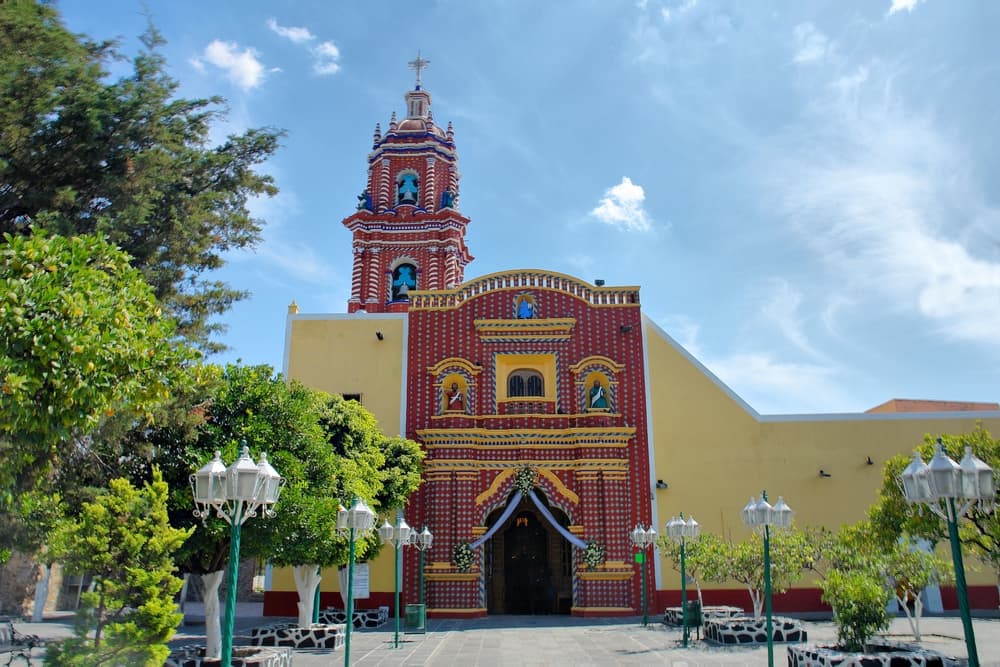
A few kilometres south of Cholula's centre, the Santa María Tonantzintla temple stands as one of the finest examples of Mexican popular baroque. Its austere red-brick exterior contrasts strikingly with an interior entirely clad in polychrome stucco, Talavera ceramics, and indigenous figures. This blend of Catholic iconography and Nahua symbolism makes it a singular landmark in the history of Mexican colonial art.
Quick practical information
- Entry: free (donations welcome)
- Dress code: respectful attire required — shoulders and knees must be covered
- Suggested duration: 30 to 45 minutes
- Access: combi (shared minibus) from Cholula's zócalo heading towards San Andrés Tonantzintla
- Rules: active place of worship — silence and discretion required during services
What you'll see
The interior is entirely lined with gilded and polychrome stucco, modelled by indigenous artisans in the 17th and 18th centuries. Angels with Nahua features, tropical fruits, flowers, and Catholic saints mingle without apparent hierarchy. The ceiling, pilasters, and retables form an ensemble of rare visual density. The brick and Talavera ceramic façade already hints at the richness within.
History and context
Construction began in the 16th century on a pre-Hispanic sacred site dedicated to Tonantzintla, a Nahua mother goddess. Franciscan friars erected an initial chapel, then villagers gradually transformed the interior between the 17th and 18th centuries. Local artisans, not Spanish masters, carved the stucco — hence the persistent presence of indigenous motifs within a Catholic framework. This acknowledged syncretism lies at the heart of the place's identity.
Highlights of your visit
The polychrome stucco ceiling
Look up as you enter. The ceiling concentrates the maximum density of figures: cherubs with indigenous faces, garlands of maize and cacao, saints surrounded by tropical vegetation. Every square inch is worked with care. Take time to let your gaze circle slowly across the expanse.
The Talavera façade
The exterior, restrained in structure, is animated by Talavera ceramic tiles bearing geometric and floral motifs. This façade is characteristic of Poblano baroque and stands as a striking visual marker in the village landscape.
The main altar
The gilded altarpiece of the main altar merges figures of saints with vegetative ornament in a churrigueresque style adapted by local hands. The overall effect feels more organic than in grand colonial cathedrals.
Etiquette and visiting rules
- Active Catholic place of worship: respect services and the faithful at prayer.
- Keep your voice low inside, keep phones on silent.
- Shoulders and knees covered are mandatory.
- Do not touch the stucco or ceramics.
Photography tips
Natural light filters through lateral windows mid-morning — the best time to photograph the stucco without flash. Flash is generally forbidden and inadvisable: it flattens the relief work. A wide-angle lens captures the density of the ceiling well. Avoid service times so as not to disturb the faithful.
Location and access
The temple lies in the village of San Andrés Tonantzintla, roughly 8 km south of Cholula. From Cholula's zócalo, shared combis regularly service the village. By car, the route is straightforward from San Andrés Cholula. The site is not wheelchair-accessible due to steps at the main entrance.
Naturally combine it with the Capilla Real de Cholula and the Great Pyramid of Cholula, both reachable by combi or taxi.
Nearby
- Great Pyramid of Cholula — the world's largest pyramid by volume, crowned with a colonial church.
- Capilla Real de Cholula — chapel with multiple domes, a rare example of colonial open basilica-plan architecture.
- San Francisco Acatepec Temple — minutes from Tonantzintla, its façade entirely covered in Talavera, even more spectacular from the outside.
- Cholula's Zócalo — lively central square, the ideal starting point to explore the region.
Frequently asked questions
Entry is free. A donation in the collection box is welcome and helps maintain the site.
Photography is generally tolerated without flash. Avoid photographing during services and remain discreet around the faithful at prayer.
San Francisco Acatepec temple is minutes away on foot or by combi. The Great Pyramid and Cholula's centre are twenty minutes' reach. Half a day covers all three sites.
Shoulders and knees covered are mandatory. Avoid short shorts and tank tops. A light scarf or jacket suffices if visiting in summer.
Local guides offer combined Tonantzintla–Acatepec–Pyramid tours from Cholula's centre. Inquire through your agency or at Cholula's tourism office.
The main entrance has steps. The interior is level once past the threshold, but wheelchair users will find the entrance challenging.
Interested in this visit?
We can include it in your personalised itinerary.