Monte Albán
Monte Albán
An ancient Zapotec capital perched at 1,940 m above Oaxaca, Monte Albán brings together pyramids, painted tombs and a ball court on a ridge designated a UNESCO World Heritage Site.
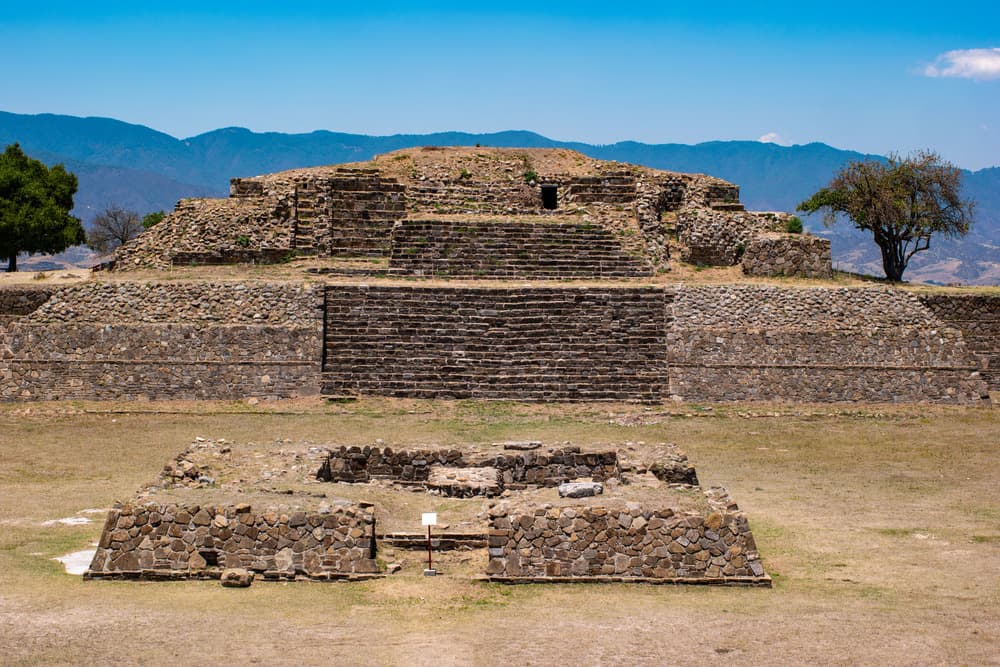
Perched at 1,940 meters above the valleys of Oaxaca, Monte Albán is the ancient Zapotec capital. Founded around 500 BCE on a ridge leveled by its builders, the site comprises pyramids, painted tombs, a ball court, and carved stelae arranged across a vast ceremonial esplanade. Inscribed as a UNESCO World Heritage Site since 1987, it ranks among the great archaeological complexes of Mexico.
Why visit Monte Albán
Monte Albán combines three rarely matched attributes:
- A historical depth spanning over a millennium of continuous occupation, from the Late Preclassic period until abandonment around 800 CE.
- Exceptional ceremonial architecture, including its Gran Plaza stretching 300 meters long, Building J with its pentagonal floor plan, and a remarkably well-preserved ball court.
- A 360-degree panorama over the valleys of Etla, Tlacolula, and Zimatlán, explaining the Zapotecs' strategic choice of this location.
Plan for a half-day visit (3 to 4 hours) to explore the entire site at leisure, including the small site museum.
History of the Zapotec site
Monte Albán emerged around 500 BCE, when the city shared common features with other Zapotec centers like Dainzú and Yagul. By 300 BCE, during the Niza phase, the city expanded rapidly: Building J was erected and the population reached approximately 17,000 inhabitants. Regular exchanges with Teotihuacan are confirmed by the presence of a Zapotec quarter in the great city of the central plateau.
Between 400 and 600 CE, during the Pitao phase, these ties strengthened. Some scholars suggest that Teotihuacan's elite influenced Monte Albán, though construction slowed and part of the population dispersed to other sites like San José Mogoté.
From 500 to 800 CE, the Xoo phase marked a revival: new construction projects, distinctive ceramic styles, and a possible return to local autonomy after Teotihuacan's withdrawal. A period of drought may have also prompted the construction of several religious buildings meant to appease the deities. The city was gradually abandoned around 800 CE, likely because maintaining such a large settlement at this altitude became increasingly difficult. The site remained visited for ritual offerings and burials of high-ranking individuals, as evidenced by the famous Tomb 7. Monte Albán was inscribed as a UNESCO World Heritage Site in 1987.
What to see on-site
The site occupies a ridge arranged in terraces in the municipality of Santa Cruz Xoxocotlán, approximately 9 km from Oaxaca city. At the heart of the complex, the Gran Plaza measures 300 meters long by 200 meters wide. Three pyramids (I, H, and G) and the enigmatic Building J occupy its central axis.
Building J
One of Mesoamerica's most singular structures. Its pentagonal arrow-shaped floor plan and angles offset 45 degrees from neighboring constructions suggest an astronomical function still debated among scholars.
The Building of the Danzantes
Dating from Period I, it is famous for its carved stones depicting nude figures in contorted postures. Long interpreted as dancers, these figures are now more commonly viewed as prisoners, sacrificial victims, or individuals with physical deformities. The hypothesis of ball players has also been proposed.
The Great Ball Court
Located northeast of the Gran Plaza, this I-shaped court measures 40 meters long by 7 to 22 meters wide depending on the section. Slanted side walls, a staircase on the north side, corner niches, and traces of mural paintings remain visible.
Tomb 104
Dating between 500 and 700 CE, it lies beneath the courtyard of a refined residence. Above the entrance, an earthenware funerary urn depicts Pitao Cozobi, the maize god. The interior walls bear paintings showing priests holding sacks of copal, the resin used in rituals.
Tomb 7
Characteristic Zapotec architecture, with an antechamber, vaulted chamber, and glyphs indicating the dates "day flower" and "year serpent." Archaeologists discovered urns of the gods Cocijo and Huehueteotl, along with a human skull decorated with turquoise and shells, now interpreted as a representation of Tezcatlipoca. Associated treasures (gold, silver, copper, mother-of-pearl, turquoise, obsidian, jade, and coral) show clear Mixtec influence. Most of these objects are displayed at the Museum of Cultures of Santo Domingo in downtown Oaxaca.
Stelae and bas-reliefs
Several standing stones bear symbols and dates in a style reminiscent of Olmec and Maya writing, testifying to connections between major Mesoamerican cultures.
Practical information
- Hours: open in the morning through mid-afternoon daily. Check current hours on the official INAH website before your visit.
- Admission: paid entry (moderate fee), free on Sundays for Mexican citizens and residents.
- Duration: 2.5 to 4 hours depending on your pace.
- Equipment: hat, water, sunscreen, and closed-toe shoes. The site is exposed and the altitude (1,940 m) intensifies sun exposure.
When to visit
November through April offers the best conditions: clear skies, mild temperatures, and minimal rainfall. The wet season (June to September) can interrupt visits with afternoon showers. Arrive at opening time to take advantage of raking light on the pyramids and avoid midday heat. Sundays see noticeably higher crowds due to free admission for national visitors.
How to get there
From downtown Oaxaca, several options are available:
- Tourist minibus: several agencies on Mina street offer round-trip shuttles with fixed return times. This is the most popular option for travelers.
- Public bus: departures from the second-class terminal toward "Colonia Monte Albán." The stop is about 1 km from the site, requiring either a walk or a moto-taxi ride.
- Taxi: direct ride from downtown, approximately 20 minutes.
- Guided tour: many Oaxaca agencies combine Monte Albán with a craft workshop or another archaeological site in the valley.
Nearby attractions
Monte Albán easily pairs with a broader exploration of Oaxaca and the surrounding region:
- Oaxaca: the colonial city, its listed historic center, its markets, and the Museum of Cultures of Santo Domingo, home to the treasures of Tomb 7.
- The associated sites of Atzompa and El Gallo, on neighboring hills, which enhance understanding of the broader Zapotec urban complex.
- Mexico City's historic center and Coyoacán, natural stops before or after Oaxaca on a Mexico circuit.
Frequently asked questions
Frequently asked questions
Plan for 2.5 to 4 hours to explore the entire site, including the Gran Plaza, accessible tombs, the Building of the Danzantes, and the small entrance museum.
The structure is visible at the site, but most of the artifacts discovered (gold, jade, turquoise-decorated skull) are displayed at the Museum of Cultures of Santo Domingo in downtown Oaxaca.
Yes, the site is freely accessible once you've paid entry, and signage is adequate. A guide (on-site or through an agency) adds genuine value in deciphering Building J, the Danzantes, and the glyphs.
November through April during the dry season. Arrive at opening for morning light and to avoid midday heat at altitude.
Access remains challenging: the site has numerous stairs, uneven surfaces, and significant elevation changes. Only certain areas near the entrance are practicable with limited mobility.
Plan your trip
Monte Albán fits naturally into a circuit around Oaxaca, complementing visits to Zapotec markets, mezcal distilleries, and other archaeological sites in the valley. To build a custom itinerary, explore our Mexico journeys.
Nearby
Interested in this visit?
We can include it in your personalised itinerary.